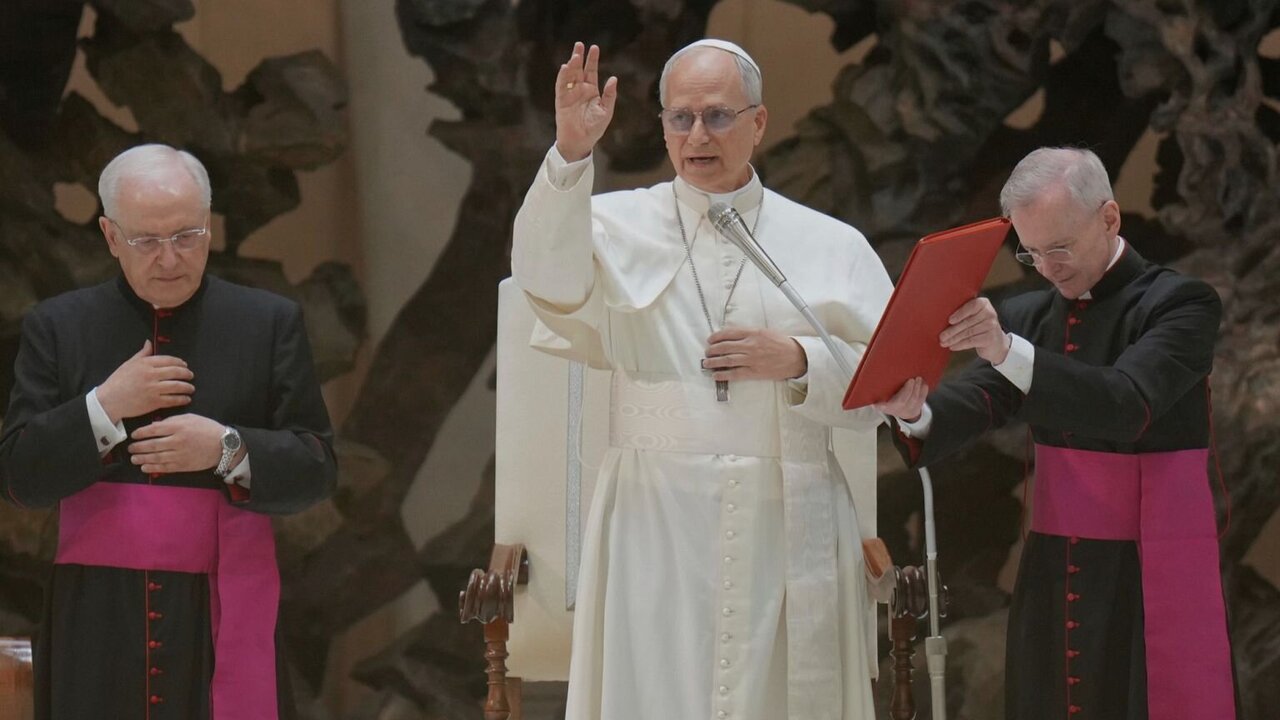
Echoes of the Desert: Pope Leo’s Algerian Pilgrimage Traces Roots of a Holy Calling
ALGIERS, Algeria — In a visit laden with diplomatic significance and profound personal resonance, Pope Leo arrived in Algeria today, marking a historic pontifical journey that many observers say is less a formal state visit and more a spiritual homecoming. For the Holy Father, this sun-baked North African nation is not merely a stop on the global stage, but the crucible where his own priestly vocation was forged, a place he returns to as the shepherd of a billion Catholics, yet also as Brother Julian, the young novice who once walked its dusty paths.
The Vatican has framed the visit as an initiative for interfaith dialogue and cultural exchange, a natural extension of Pope Leo’s pontificate, which has consistently championed peace and mutual understanding across religions. However, for those familiar with his biography, the journey to Algeria is deeply personal. Before his ascension to the papacy, Cardinal Julian Valerius spent his formative years as a member of the enigmatic ‘Order of St. Augustine’s Desert Sons,’ an ascetic and scholarly congregation with a centuries-old footprint in North Africa, committed to contemplation, scholarship, and quiet interfaith engagement.
The Desert Sons: A Legacy of Dialogue
Founded in the 13th century, drawing inspiration from St. Augustine of Hippo’s North African heritage, the Desert Sons established themselves in the Maghreb, often in remote monastic communities. Their mission, distinct from many European missionary orders, focused not on conversion but on deep theological study, cross-cultural understanding, and charitable works alongside Muslim communities. They became renowned for their mastery of Arabic, their preservation of ancient texts, and their quiet advocacy for coexistence during tumultuous periods.
It was to one of their secluded monasteries in the Aurès Mountains, near Timgad, that the young Julian Valerius was drawn in his early twenties. Seeking a life of intellectual rigor and spiritual depth, he spent nearly a decade there, immersing himself in patristic theology, Islamic philosophy, and the vibrant tapestry of Algerian culture. Sources close to the Vatican confirm that it was in Algeria that Brother Julian cultivated his characteristic humility, his profound intellectual curiosity, and his unwavering commitment to bridge-building.
“His time in Algeria, with the Desert Sons, fundamentally shaped his vision of the Church and its role in the world,” explained Father Thomas O’Malley, a Vatican historian. “He learned firsthand the complexities and beauty of interfaith relations, not from textbooks, but through shared meals, intellectual debates, and daily life with his Muslim neighbors. This isn’t a theoretical Pope; it’s a Pope whose compassion and understanding are rooted in lived experience.”
A Pilgrimage to Personal and Historical Sites
Pope Leo’s itinerary reflects this deeply personal connection. Beyond official meetings with President Abdelmadjid Tebboune and other dignitaries, his schedule includes a quiet visit to the ruins of Hippo Regius, St. Augustine’s ancient see, a pilgrimage site of immense significance for the Desert Sons. More poignantly, he is expected to make a private stop at the now-abandoned monastery in the Aurès where he began his priestly journey, a place of personal reflection away from the glare of global media.
The Algerian government, while acknowledging the religious dimension, is keen to emphasize the diplomatic and cultural aspects of the visit. “This visit symbolizes the long-standing ties between Algeria and the Holy See, and indeed, between our diverse cultures,” stated a spokesperson for the Algerian Ministry of Foreign Affairs. “We welcome His Holiness not just as a global leader, but as a friend who understands and appreciates the rich history and spirit of our nation.”
For Algeria, a nation with a predominantly Muslim population but a small, historically significant Christian minority, the Pope’s visit offers a powerful affirmation of its tradition of religious tolerance. The Desert Sons, though never numerous, left an indelible mark through their schools, hospitals, and their quiet witness to a different model of Christian presence in a Muslim land. Pope Leo’s return pays homage not only to his personal path but to this broader, often forgotten, history of coexistence.
A Message for a Fractured World
In a world grappling with rising xenophobia and religious polarization, Pope Leo’s Algerian pilgrimage carries a potent symbolic weight. His history as a “Desert Son” makes him uniquely qualified to speak to the urgent need for empathy and dialogue. His early experiences in Algeria, a place marked by colonial legacies and post-independence struggles, informed his nuanced understanding of identity, justice, and the often-painful path to reconciliation.
As Pope Leo begins his journey through Algeria, from the bustling markets of Algiers to the contemplative solitude of the Aurès, his every step will echo with the footsteps of Brother Julian. It is a return that transcends diplomatic niceties, offering a profound lesson in how personal history, when rooted in a calling for service and understanding, can illuminate the path for global peace. The Desert Sons, in their quiet wisdom, may well have prepared a Pontiff uniquely suited to navigate the complexities of the 21st century, guiding him back to the very springs of his faith in the sands of Algeria.