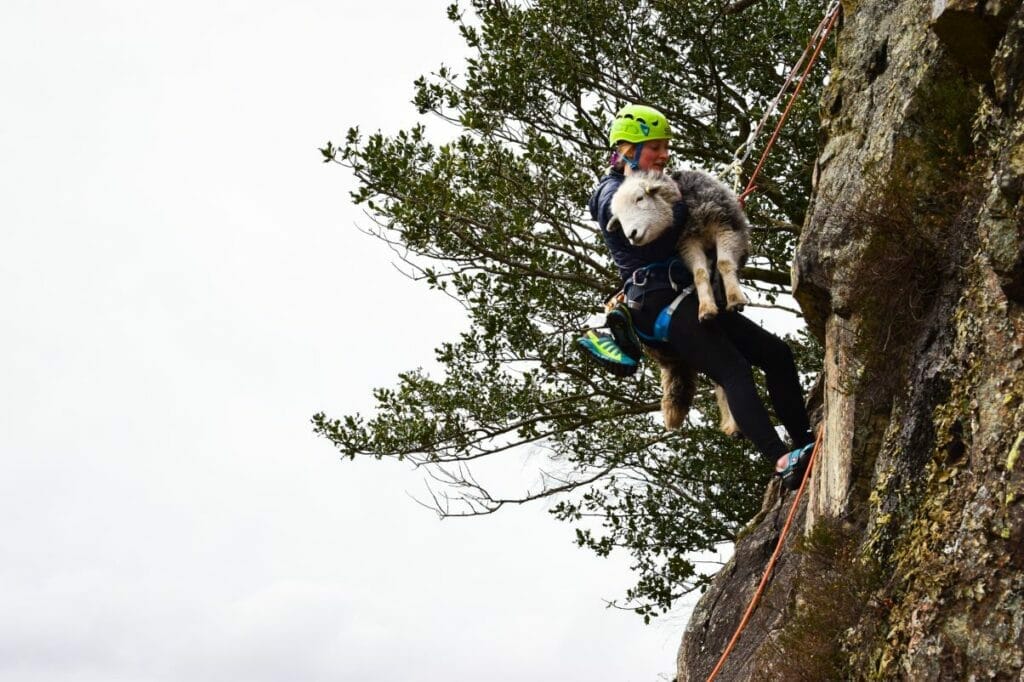
Daring Cliffside Rescue: Tourists Plucked to Safety in Thrilling Australian Operation
In a dramatic and meticulously executed operation, a group of six international tourists was safely rescued from a perilous cliff face along Australia’s rugged coastline. The three-hour ordeal, widely reported by news outlets including CBS News, saw emergency services battle formidable natural elements and rapidly fading daylight to pluck the stranded adventurers to safety, underscoring the extraordinary bravery and technical prowess of Australia’s rescue teams.
The incident unfolded on a recent Tuesday afternoon near the picturesque, yet inherently dangerous, cliffs of the Royal National Park, just south of Sydney. The group, comprising individuals from the United States, the UK, and Germany, had reportedly ventured off a well-marked walking track. What began as an innocent exploration quickly turned into a terrifying predicament when they found themselves trapped on a narrow, unstable ledge, hundreds of feet above the churning Tasman Sea, with no safe path either up or down. A rising tide threatened their precarious perch, and approaching dusk promised plummeting temperatures and diminished visibility.
The Perilous Predicament and the Urgent Call
The alarm was raised around 3:30 PM when one of the tourists managed to gain a sporadic mobile signal and dial emergency services. The distress call described a harrowing scene: six individuals, clinging to a slippery rock shelf, buffeted by strong winds and the spray of crashing waves. Initial assessments by NSW Police confirmed the severity of the situation. The location was remote and challenging to access, characterized by sheer sandstone cliffs and treacherous undercurrents below. It was immediately clear that a standard ground-based rescue would be impossible, necessitating a multi-agency response.
Within minutes, a coordinated rescue effort was mobilized. Officers from NSW Police, paramedics from Ambulance NSW, and volunteers from the State Emergency Service (SES) converged on the Royal National Park. The Westpac Life Saver Rescue Helicopter was also scrambled, providing crucial aerial reconnaissance and potential direct extraction. The clock was ticking, not only against the rapidly setting sun but also against the deteriorating mental and physical state of the trapped tourists, who were exposed to the elements and growing increasingly anxious.
A Race Against Time: Mobilizing Elite Rescue Teams
“This wasn’t just a rescue; it was a high-stakes, real-time puzzle,” stated Inspector David Thompson of the NSW Police, who oversaw the operation. “The primary challenges were the sheer height, unstable rock, and the very real risk of a tidal surge. Every decision had to be precise, and every rescuer at the top of their game.”
The first priority was to establish a secure anchor point at the top of the cliff. Highly trained SES rope access technicians began the painstaking process of setting up a complex system of ropes and pulleys. Their task was made even more difficult by strong gusts of wind that threatened to dislodge gear and make rappelling dangerous. Simultaneously, paramedics prepared for retrieval, ready with medical supplies to treat potential injuries, hypothermia, or shock.
As the sun dipped lower, casting long shadows, two lead rescuers – an SES team leader and an Ambulance NSW special operations paramedic – commenced their descent. Slowly, meticulously, they rappelled down the unforgiving cliff face, communicating constantly with the command post. The journey down was fraught with danger, with loose rocks threatening to dislodge and the wind whipping at their gear.
The Critical Extraction: Hoisted to Safety
Upon reaching the stranded tourists, approximately 200 feet below the cliff top, rescuers immediately assessed their condition. While shaken and cold, thankfully, no one had sustained serious physical injuries. Paramedics provided immediate comfort, offering warm blankets and reassuring words to calm the frightened group. The real work, however, was just beginning: the individual extraction.
The rescue strategy involved winching each tourist, one by one, into the Westpac Life Saver Rescue Helicopter. This required extraordinary coordination. The helicopter hovered precariously close to the cliff face, battling turbulent air currents. Each tourist was carefully fitted into a harness, secured by the rope technicians, and then slowly winched upwards, a terrifying but ultimately life-saving journey into the helicopter. The process was agonizingly slow, each lift taking several minutes of precise maneuvering by the pilot and the winch operator.
“The moment that first person was safely onboard, you could feel a wave of relief spread through the entire team,” recounted Sergeant Emily Green, one of the ground support officers. “It’s an incredibly delicate dance between the ropes team, paramedics, and the helicopter crew. One misstep, and the consequences could be dire.”
The 3-hour operation culminated shortly after 6:30 PM, just as the last vestiges of daylight disappeared. All six tourists were safely airlifted from the cliff and transported to a nearby staging area where they underwent thorough medical examinations. Apart from minor scrapes, some dehydration, and significant emotional shock, they were declared to be in good health.
Heroism and a Timely Reminder for Adventurers
The successful rescue stands as a powerful testament to the skill, courage, and seamless inter-agency cooperation of Australia’s emergency services. Inspector Thompson praised the collective effort: “It truly was a team effort. From the initial call handlers to the ground support, the rope technicians, the paramedics, and the incredibly skilled helicopter crew – everyone played a vital role in bringing these people home safely.”
The rescued tourists expressed profound gratitude. “We are incredibly lucky to be alive,” said one American tourist, visibly emotional. “These people are heroes. We made a mistake, and they saved us.”
This dramatic event serves as a critical reminder to both locals and international visitors about the inherent dangers of venturing off marked trails, particularly in Australia’s wild and often unforgiving natural landscapes. While the allure of untouched beauty is strong, the perils of coastal cliffs, rapidly changing tides, and unpredictable weather conditions can quickly turn an adventure into a life-threatening situation. The swift, professional, and daring response of Australia’s emergency services ensured that this story had a happy, rather than tragic, ending.