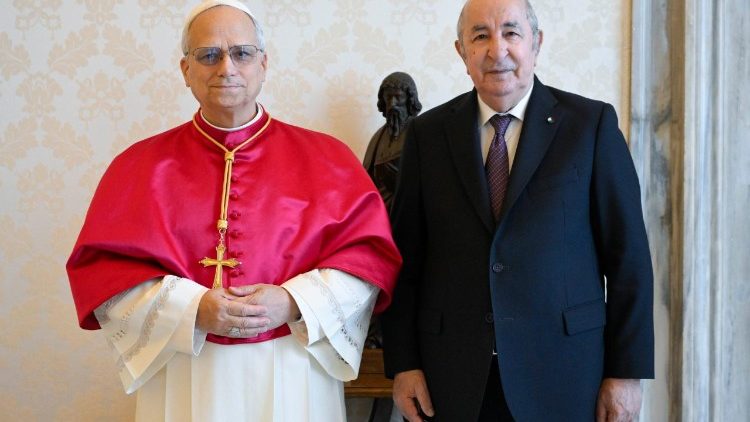
Pope Leo Makes Historic First Visit to Algeria, Kicking Off Landmark Africa Tour
ALGIERS, Algeria – Pope Leo arrived in Algiers today, marking a momentous and unprecedented visit as the first pontiff ever to step foot on Algerian soil. The historic trip signals the beginning of a major, multi-nation African tour for the Holy Father, underscoring the Vatican’s renewed commitment to interfaith dialogue, peace-building, and engagement with the continent’s diverse cultures and complex challenges.
Upon his arrival at Houari Boumediene Airport, Pope Leo was greeted by President Abdelmadjid Tebboune and a host of religious and political dignitaries, amidst tight security and anticipation. The visit, years in the making, is seen as a crucial step in fostering reconciliation and understanding in a nation with a rich Islamic heritage, a complex relationship with its colonial past, and a small but vibrant Christian community.
Algeria, a predominantly Muslim nation of over 44 million, holds a unique position in the Maghreb and Arab world. Its history, marked by a brutal war of independence and a devastating civil conflict in the 1990s, has left deep scars. For decades, the presence of the Catholic Church in Algeria has been largely a quiet one, often associated with the French colonial era or humanitarian work. This visit by the head of the Catholic Church carries immense symbolic weight, aiming to transcend historical divisions and build bridges of mutual respect.
Addressing the press shortly after his arrival, Vatican spokesman Matteo Bruni emphasized the Pope’s objectives: “His Holiness comes as a pilgrim of peace and a messenger of hope. He seeks to strengthen the bonds of fraternity between Christians and Muslims, to honor the martyrs of both faiths, and to encourage all Algerians in their journey towards lasting peace and social cohesion.” Bruni highlighted that Pope Leo’s itinerary in Algeria is designed to reflect these goals, balancing state engagements with interreligious dialogue and pastoral care for the local Catholic community.
A cornerstone of the Algerian leg of the tour will be Pope Leo’s meeting with Grand Imam Sheikh Mohamed Tayeb, a leading figure in Islamic scholarship and interfaith initiatives. This encounter is expected to culminate in a joint declaration emphasizing shared values, religious freedom, and a commitment to working together for global peace and justice. Such a gesture would echo previous papal efforts to engage with Sunni Islam’s highest authorities, deepening the Vatican’s diplomatic push for interfaith harmony.
Beyond the diplomatic and interfaith engagements, Pope Leo will celebrate Mass at the Notre Dame d’Afrique Basilica, a significant spiritual landmark overlooking Algiers. This event will provide an opportunity for the country’s small Catholic community – comprising foreign workers and a dwindling number of Algerian converts – to connect directly with their spiritual leader. He is also scheduled to meet with young people and representatives of charitable organizations, offering words of encouragement and solidarity to those working at the grassroots level.
Choosing Algeria as the starting point for this extensive African tour is highly significant. It signals the Vatican’s intent to engage with North Africa not just as a region facing migration challenges, but as a crucial area for interreligious understanding and a more inclusive global society. Following his time in Algeria, Pope Leo is expected to visit several other sub-Saharan African nations, where he will address issues ranging from poverty and climate change to conflict resolution and the empowerment of women.
Analysts worldwide are closely watching the visit’s reception. Dr. Aisha Rahman, a North Africa specialist at the University of London, noted, “This is more than a diplomatic visit; it’s a profound statement. For Algeria, it offers a moment to showcase its commitment to religious tolerance and reconciliation after years of isolation. For the Vatican, it’s an opportunity to project a message of universal brotherhood into a region often overlooked by major global religious leaders.”
The journey also recalls the tragic stories of the Tibhirine monks, seven French Cistercians kidnapped and killed in Algeria in 1996 during the civil war. Beatified in 2018 alongside 12 other religious martyrs, their sacrifice remains a poignant symbol of faith amidst violence. Pope Leo’s visit is expected to include a moment of remembrance for these and all victims of the “Black Decade,” cementing the theme of healing and shared remembrance.
As Pope Leo embarks on this historic mission, the eyes of both the Catholic world and broader international community are fixed on Algiers. The visit is not merely ceremonial but a carefully calibrated diplomatic and spiritual endeavor designed to build bridges, heal old wounds, and lay the groundwork for a future characterized by greater understanding and cooperation between faiths and nations across Africa. Its success could ripple far beyond Algeria’s borders, setting a precedent for peaceful coexistence in a complex world.