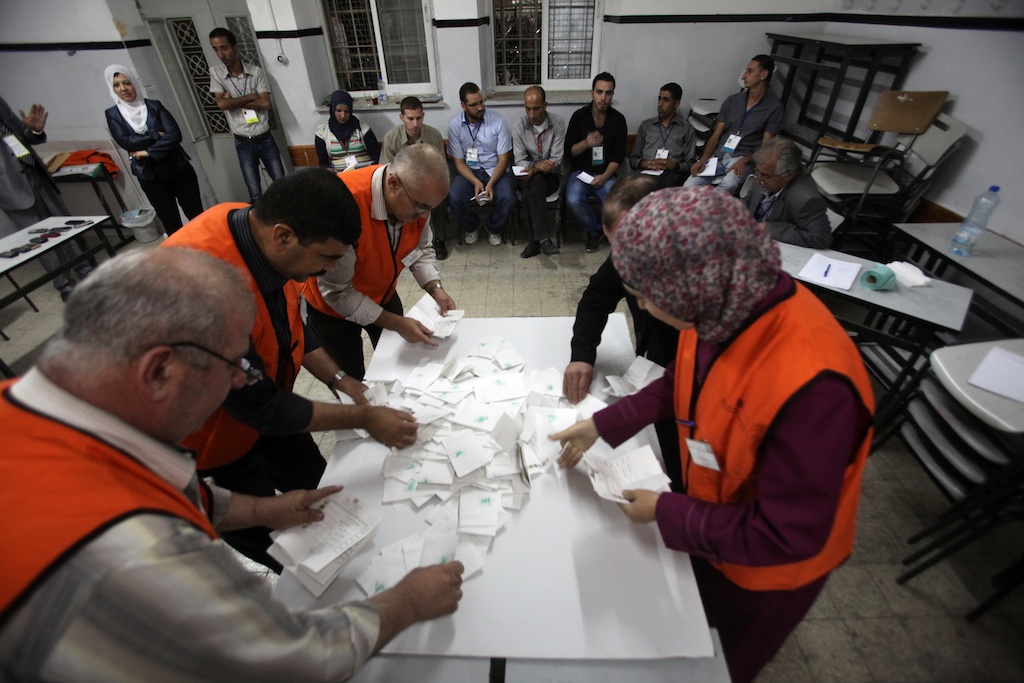
RAMALLAH, West Bank – Palestinians in the West Bank and limited parts of the Gaza Strip went to the polls on Saturday to elect local municipal councils, a democratic exercise that, while crucial for daily governance, underscored the deep political divisions plaguing the Palestinian territories. The elections, primarily held in the Israeli-occupied West Bank, proceeded largely without incident, with international observers noting the generally calm proceedings despite the political backdrop. Voters cast ballots for candidates promising better services and local development amidst a prolonged absence of national legislative and presidential elections.
The ballot boxes opened for a significant portion of the West Bank’s 1.2 million eligible voters in 154 localities, while only 16 predominantly Christian communities and isolated Bedouin villages in the Gaza Strip participated. The ruling Hamas movement, which controls Gaza, boycotted the elections across most of the enclave, arguing that national reconciliation and comprehensive legislative and presidential elections must precede local polls. This boycott deepened the existing chasm between the Hamas-controlled Gaza Strip and the Fatah-dominated Palestinian Authority (PA) in the West Bank, highlighting a persistent political paralysis that has left Palestinians without a national vote for over a decade.
A Local Focus Amidst National Stalemate
For many Palestinians, these local elections represent the only opportunity to exercise their democratic rights and hold officials accountable, even if only at the municipal level. The last Palestinian legislative elections were held in 2006, resulting in a Hamas victory that was not recognized internationally and ultimately led to the bitter Fatah-Hamas split in 2007. Presidential elections last took place in 2005. This protracted democratic deficit has fueled widespread disillusionment and apathy among the Palestinian populace, who often express frustration over the lack of progress on fundamental political issues, including the Israeli occupation and the pursuit of statehood. The absence of national elections means there is no clear mandate for a unified national leadership, creating a void that local elections, while vital, cannot truly fill.
“We are here to choose who will serve our community, who will fix our roads, manage our waste, and improve our schools,” said Fatima Abu Hamad, a 55-year-old voter in Ramallah, after casting her ballot. “It’s not about big politics or the occupation. It’s about our daily life, and we hope these new councils can make a real difference.” Such sentiments were echoed by many voters, who view municipal councils as essential for the provision of basic services in their towns and villages, especially in areas where the PA’s reach is limited or resources are scarce.
The Logistics of the Vote
The Palestinian Central Elections Commission (PCEC) oversaw the logistics, deploying thousands of staff and volunteers to manage the polling stations. Strict health protocols, including mask-wearing and social distancing, were implemented in response to the ongoing COVID-19 pandemic. Security was provided by Palestinian Authority forces in the West Bank, ensuring a generally peaceful and orderly voting process. Hundreds of candidates across dozens of electoral lists contested the seats, representing a diverse range of local interests and affiliations. The diverse slate of candidates, though often aligned with Fatah or other smaller factions, presented voters with a choice, albeit within a circumscribed political environment.
Approximately 1.2 million Palestinians in the West Bank were eligible to vote across the 154 participating local government units. In Gaza, the much smaller number of voters in the 16 participating areas underscored the limited scope of the elections there. These included several Christian towns and villages, where local leaders explicitly requested to participate, and some Bedouin communities, which often maintain a degree of autonomy from mainstream political factions. The decision by Hamas to largely prevent elections in Gaza was vehemently criticized by the PA, which views it as an obstruction of democracy and a further entrenchment of the division.
Challenges and Critiques
Despite the PA’s insistence on upholding democratic principles through these local elections, turnout figures remained a key point of analysis and concern. Historically, local elections have seen lower participation rates compared to national polls, partly due to voter fatigue and a perception that local councils have limited power to effect change. This apathy stems from a combination of factors: deep disillusionment with the political factions, a belief that corruption is widespread within certain administrative bodies, and the overarching reality that even the most effective local council cannot alter the fundamental challenges posed by the Israeli occupation or the lack of national sovereignty. Critics argue that holding local elections in a fragmented manner, particularly with Gaza largely excluded, only serves to legitimize the existing division rather than paving the way for true national unity.
Dr. Khalil Shikaki, a prominent Palestinian pollster and political analyst, noted that “while these elections are important for local governance and institutional building, they cannot bridge the deep political divide between Fatah and Hamas, nor can they address the core issues of occupation and statehood. They serve as a vital pressure release valve and a mechanism for local accountability, but they do not substitute for comprehensive national elections that are urgently needed for legitimate representation.” He added that the fragmented nature of the voting further cemented the existing political realities rather than offering a path toward unity.
Looking Ahead
The results of these local elections are expected to bring new faces and renewed mandates to municipal councils across the West Bank. However, their broader impact on the Palestinian political landscape remains limited. Without a breakthrough in Fatah-Hamas reconciliation and a clear path toward national elections, the democratic aspirations of the Palestinian people will continue to be channelled through localized, often fragmented, electoral processes. The international community, while often calling for Palestinian democratic renewal, has largely remained observers in the immediate aftermath of these localized polls, with no significant push expected for broader national elections absent a major political shift. The municipal elections, therefore, serve as a poignant reminder of a society striving for self-governance and accountability at the grassroots level, even as it grapples with a prolonged national political vacuum and the pervasive realities of occupation, alongside a pressing need for a unified national vision.
As the polling stations closed and ballot counting began, the hopes of many residents rested on the shoulders of these newly elected local leaders to deliver tangible improvements to their daily lives. Yet, the shadow of a divided political future and the yearning for a unified national voice loomed large over the democratic exercise, underscoring the complex and often paradoxical nature of Palestinian self-determination.