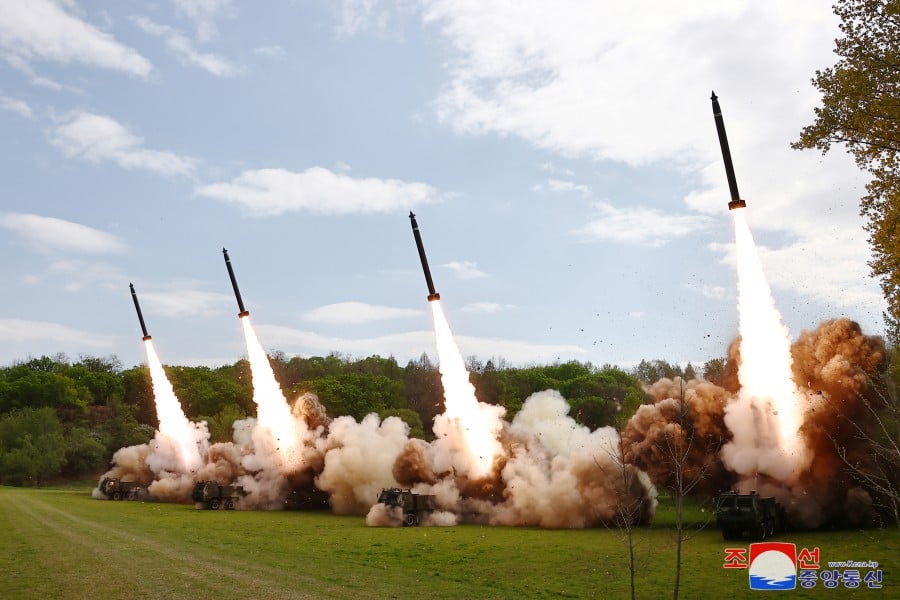
North Korea Launches Multiple Ballistic Missiles, Heightening Regional Tensions Amid Stalled Diplomacy
SEOUL/TOKYO/WASHINGTON – North Korea has once again ratcheted up tensions on the Korean Peninsula and across East Asia, launching multiple short-range ballistic missiles (SRBMs) towards its eastern coast and into the Sea of Japan, also known as the East Sea. The latest provocation, reported by various international outlets, including Politico, underscores Pyongyang’s unwavering commitment to advancing its illicit weapons programs despite international condemnation and stringent sanctions. This act of defiance typically aims to test new capabilities, express discontent with ongoing joint military drills by the United States and South Korea, and assert its military prowess on the global stage.
The launches were detected by South Korea’s Joint Chiefs of Staff, which swiftly reported the event and indicated that the missiles flew a considerable distance before splashing down in the waters. Japanese authorities also confirmed the launches, condemning them as a threat to regional and international peace and stability. While details on the exact type, range, and altitude of the missiles are often subject to further analysis, North Korea has frequently utilized SRBMs to hone its delivery systems, often with a focus on evading missile defense systems in the region. These tests are a direct violation of multiple United Nations Security Council resolutions that explicitly prohibit North Korea from engaging in any ballistic missile activity.
A Pattern of Provocation and Defiance
Pyongyang’s latest missile launch is not an isolated incident but rather fits into a well-established pattern of provocations under the leadership of Kim Jong Un. The regime views its nuclear and missile capabilities as essential for its survival, a deterrent against what it perceives as hostile policies from the United States and its allies. Over the past few years, North Korea has significantly accelerated its weapons development, showcasing an increasingly diverse arsenal that includes intercontinental ballistic missiles (ICBMs) capable of reaching the U.S. mainland, submarine-launched ballistic missiles (SLBMs), and various cruise missiles.
These tests frequently coincide with or follow joint military exercises conducted by the United States and South Korea, which Pyongyang decries as rehearsals for an invasion. While Washington and Seoul maintain that these drills are defensive in nature and crucial for maintaining readiness, North Korea interprets them as a direct threat, often responding with missile tests to demonstrate its own capabilities and resolve. This tit-for-tat cycle of action and reaction has become a dangerous constant in a highly volatile region, making any path towards de-escalation increasingly challenging.
International Condemnation and Stalled Diplomacy
Immediately following the launches, international reactions were swift and largely condemnatory. South Korea’s government expressed strong regret and urged Pyongyang to cease all provocative actions immediately, reiterating its commitment to bolstering its defense posture in coordination with the United States. Japan, a key U.S. ally and frequently within range of North Korean missiles, echoed these sentiments, with its Ministry of Defense and Prime Minister’s office vowing to gather intelligence and ensure the safety of its citizens.
The United States State Department condemned the launches, calling them a serious threat to regional stability. Washington reaffirmed its ironclad security commitments to both South Korea and Japan and reiterated its standing offer for dialogue with Pyongyang without preconditions. However, denuclearization talks have remained stalled since the collapse of the Hanoi summit between Kim Jong Un and then-President Donald Trump in 2019. North Korea has consistently rejected U.S. overtures, demanding an end to hostile policies and sanctions relief as preconditions for any meaningful engagement, a stance that Washington has been unwilling to fully concede.
Implications for Regional Security and Global Diplomacy
The continued advancement of North Korea’s missile program poses significant implications for regional security and global non-proliferation efforts. Each test provides Pyongyang with valuable data, refining the accuracy and reliability of its systems, and potentially increasing the lethality of its arsenal. For South Korea and Japan, the proximity of these tests translates into heightened anxiety and prompts further investment in their own defensive capabilities, often with U.S. assistance.
On the diplomatic front, the situation remains at an impasse. The United Nations Security Council, tasked with maintaining international peace and security, often finds itself deadlocked on North Korea issues, with veto-wielding members China and Russia frequently advocating for a reduction in sanctions or blaming the U.S. and its allies for provoking the North. This division among major powers further emboldens North Korea, allowing it to continue its weapons development largely unchecked by unified international action.
Experts warn that without a renewed diplomatic push and a willingness from all parties to compromise, the cycle of provocation and condemnation is likely to persist. The current trajectory risks not only further destabilizing East Asia but also increasing the chances of miscalculation or accidental escalation. As North Korea pushes the boundaries of its military capabilities, the international community faces the daunting task of finding a viable path to denuclearization that ensures both regional security and global stability.