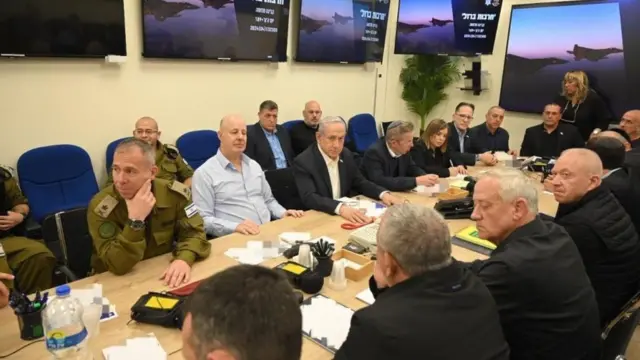
Prime Minister Declares Israel ‘Ready for Iran War Resumption’ Amid US Push for Diplomatic Talks
JERUSALEM/WASHINGTON D.C. – In a stark declaration that has reverberated across diplomatic corridors, Israeli Prime Minister Benjamin Netanyahu recently asserted that Israel stands prepared for a “resumption of war” against Iran. This forceful statement, underlining the Jewish state’s deep-seated anxieties regarding Tehran’s nuclear program and regional belligerence, comes at a critical juncture as the United States simultaneously endeavors to orchestrate another round of delicate diplomatic negotiations aimed at de-escalating tensions with the Islamic Republic.
Netanyahu’s comments, conveyed with characteristic gravitas, underscore Israel’s long-held conviction that Iran’s nuclear ambitions pose an existential threat. “We are preparing for a resumption of war with Iran, which is the root of all the evil, terror, and instability in our region,” the Prime Minister was quoted as saying. This readiness, according to Israeli officials, encompasses both defensive measures and the potential for offensive action to thwart what they perceive as an inevitable march towards nuclear weaponization. The ‘resumption’ in Netanyahu’s phrasing is critical, implying a continuity of historical conflict and a preparedness to re-engage on a more direct, military footing should diplomatic avenues fail to curb Iran’s progress.
For years, Israel has vociferously campaigned against any perceived leniency towards Iran, particularly concerning its nuclear program and its extensive network of regional proxies, including Hezbollah in Lebanon, Hamas in Gaza, and various militias in Syria and Iraq. Israeli intelligence frequently reports on Iran’s accelerating uranium enrichment activities, which have now reached unprecedented purity levels, far beyond the limits set by the collapsed 2015 Joint Comprehensive Plan of Action (JCPOA). These developments fuel Israel’s security establishment’s dire warnings, pushing for what they term a credible military option to remain firmly on the table.
Conversely, the Biden administration in Washington continues to champion a diplomatic resolution, viewing it as the most viable path to prevent a wider, potentially catastrophic, conflict in the Middle East. Secretary of State Antony Blinken and other senior US officials have been engaged in extensive back-channel communications and direct diplomatic overtures, hoping to entice Iran back to serious negotiations. The objective remains multifaceted: to restore verifiable constraints on Iran’s nuclear program, secure the release of Western hostages, and ideally, address Iran’s broader destabilizing activities in the region.
The proposed “another round of talks” represents a persistent effort by the US to revive some form of a nuclear deal, even if not a full return to the original JCPOA. US negotiators face an uphill battle. Iran has consistently demanded the complete lifting of all US sanctions imposed since 2018 as a prerequisite for any meaningful discussions, a condition Washington has been reluctant to meet entirely. Furthermore, there is deep distrust on both sides, exacerbated by the previous administration’s withdrawal from the JCPOA and Iran’s subsequent escalation of its nuclear program.
From Tehran’s perspective, its nuclear program is solely for peaceful energy purposes, and its regional military activities are purely defensive. Iran views the US sanctions as an act of economic warfare and Israel’s threats as unwarranted aggression. The internal political climate in Iran, particularly after recent leadership changes and ongoing domestic challenges, further complicates the flexibility of its negotiating stance. Hardliners within the Iranian government often perceive engagement with the West as a sign of weakness, making concessions difficult to achieve.
The implications of this dual-track approach – Israeli military readiness versus US diplomacy – are profound for the broader Middle East. A potential military confrontation between Israel and Iran, whether direct or through proxies, could rapidly engulf the region, disrupting global oil supplies, sparking humanitarian crises, and drawing in other regional and international powers. Gulf states, already wary of Iran’s influence, watch these developments with bated breath, their own security calculations constantly shifting.
International observers, including European nations who remain signatories to the JCPOA, have expressed growing alarm. They consistently call for restraint from all parties and emphasize the urgent need for a diplomatic breakthrough to avoid a dangerous escalation. The United Nations Security Council periodically reviews reports on Iran’s compliance with non-proliferation treaties, often highlighting the increasing challenges posed by Iran’s advanced centrifuges and enriched uranium stockpiles.
This precarious balance harks back to previous cycles of tension, where moments of near-conflict were averted by eleventh-hour diplomatic efforts or a recalculation of risks. However, the current landscape is arguably more volatile, with Iran’s nuclear capabilities significantly advanced, Israel’s patience seemingly wearing thin, and the US navigating a complex web of alliances and antagonisms. The fundamental dilemma persists: how to prevent a nuclear-armed Iran without triggering a devastating regional war.
As Prime Minister Netanyahu articulates Israel’s readiness for war and the US continues its diplomatic push, the international community finds itself at a critical juncture. The path ahead is fraught with peril, demanding extraordinary statesmanship and perhaps unprecedented compromises. The outcome of this high-stakes standoff will not only determine the future security architecture of the Middle East but also send powerful reverberations across global geopolitics for years to come.