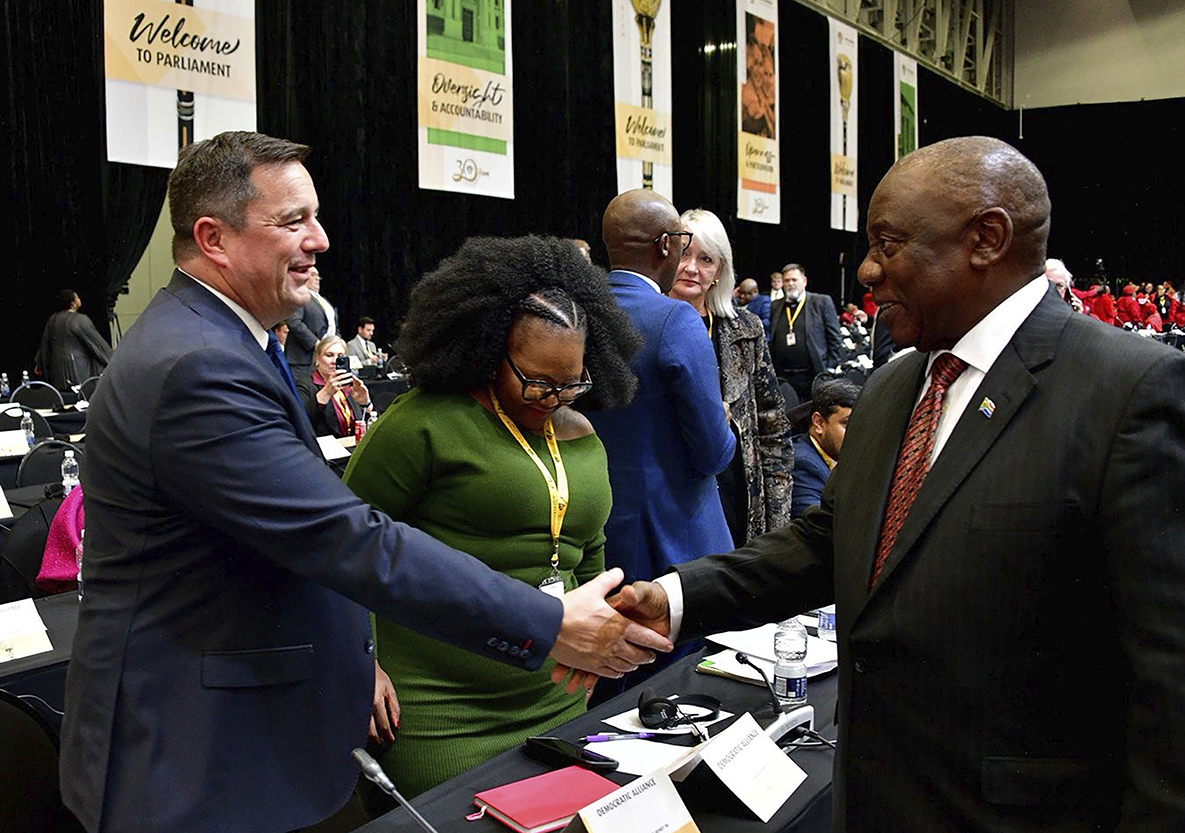
Democratic Alliance Elects New Leader, Eyes Resurgence Against ANC Ahead of Crucial Elections
JOHANNESBURG, South Africa – [Date, e.g., October 26, 2023] – South Africa’s official opposition, the Democratic Alliance (DA), has elected a new leader, signaling a renewed drive to challenge the long-dominant African National Congress (ANC). The election of [New Leader’s Name, e.g., John Steenhuisen] comes at a critical juncture for the party, which has faced internal divisions and stagnant electoral growth, as the nation gears up for pivotal general elections in 2024 amidst growing discontent with the ruling party’s performance.
The DA’s federal congress, held over the weekend, culminated in the decisive victory of [New Leader’s Name], who previously served as the party’s interim leader. His election is seen by many as a mandate for stability and a clear direction for the party, which has struggled to articulate a unified vision and broaden its appeal beyond its traditional voter base. Addressing delegates after his win, [New Leader’s Name] vowed to “fight corruption, build a non-racial South Africa, and deliver economic prosperity for all,” directly positioning the DA as the credible alternative to an ANC increasingly plagued by scandal and economic mismanagement.
For decades, the ANC has held an unshakeable grip on South African politics since the end of apartheid in 1994. However, its once-commanding majority has been steadily eroded by persistent issues of corruption, staggering unemployment, chronic service delivery failures – most notably the ongoing electricity crisis ‘load shedding’ – and widening social inequality. This decline has opened a strategic window for opposition parties, yet the DA itself has not fully capitalized on the ANC’s woes, largely due to internal strife and a perception by some that it struggles to connect with the broader, diverse South African electorate.
The leadership contest itself was a reflection of the DA’s internal tensions, pitting different factions and ideological viewpoints against each other. [New Leader’s Name] emerged victorious over [mention a hypothetical contender or simply say ‘several challengers’], promising to unify the party and refine its message to resonate more effectively with voters across racial and economic lines. His immediate task will be to quell lingering dissent, consolidate power, and present a coherent, compelling platform that offers tangible solutions to South Africa’s myriad challenges.
Analysts suggest that [New Leader’s Name]’s tenure will be defined by his ability to navigate the complex racial politics of South Africa, a nation still grappling with its past. The DA has often been criticized for failing to adequately represent the aspirations of the black majority, despite its stated commitment to non-racialism. “[New Leader’s Name] must demonstrate that the DA is a party for all South Africans, not just a segment of the population,” commented Dr. Thandeka Zuma, a political science lecturer at the University of Witwatersrand. “The success of his leadership will hinge on his ability to attract new voters while retaining the party’s core support.”
The road ahead for the DA is fraught with challenges. Beyond internal cohesion, the party must contend with a fragmented opposition landscape, including the Economic Freedom Fighters (EFF), which commands significant support, particularly among younger, disillusioned voters. The rise of smaller, regional parties and independent candidates further complicates the electoral calculations, potentially preventing any single opposition party from forming a strong coalition against the ANC.
However, the ANC itself faces its most formidable electoral test in recent memory. Opinion polls suggest that the ruling party could fall below the 50% threshold for the first time in 2024, forcing it into a coalition government – an unprecedented scenario that would fundamentally reshape South African politics. This prospect invigorates the DA, offering a concrete target to rally its base and intensify its campaigning efforts.
[New Leader’s Name]’s strategy is expected to focus heavily on good governance, fiscal discipline, and a market-friendly approach to economic growth, contrasting sharply with the ANC’s more interventionist policies and its struggles with state-owned enterprises. The DA will likely amplify its criticisms of ANC corruption and maladministration, hoping to draw a clear distinction between its vision for a functional state and what it portrays as the ANC’s failing model.
The upcoming elections will be a litmus test not only for [New Leader’s Name]’s leadership but for the health of South African democracy itself. A strengthened opposition, capable of holding the government accountable and offering viable alternatives, is crucial for fostering a robust multi-party system. The DA, under its new stewardship, faces the monumental task of convincing a weary electorate that it offers a genuine path to a brighter future, a future where the promises of 1994 are finally realized for all.
As South Africa inches closer to 2024, all eyes will be on [New Leader’s Name] and the Democratic Alliance. Their ability to translate internal unity into broad electoral appeal will determine whether this leadership change marks a genuine turning point for the party and, indeed, for the future trajectory of the nation.